Wood Types for Furniture: Sheesham, Teak, Mango Wood, and Plywood Compared
When you think of furniture, the first things that come to mind are its design, color, and price. The core of the furniture determines how old it will look, how heavy it will be, how sensitive it is to humidity, and what maintenance it requires. Indian furniture is composed of numerous kinds of solid and engineered wood, and the terminology used by furniture makers is likely to puzzle buyers. Let me give you some clarity on the topic.
What Solid Wood Means
Solid wood is wood obtained from a specific tree species without a core of chips and fibers. This wood can be worked on to form frames and panels and can also be re-finished time and time again. The solid wood responds to moisture levels by expanding when it is moist and contracting when dry. Seasoned wood, which has been dried with the right moisture content, is stable and forms strong joints. Always ensure that the wood supplied to you by your suppliers has been kiln-dried, as this is one of the most critical aspects in construction.
Sheesham Wood: Heavily Used and Dense
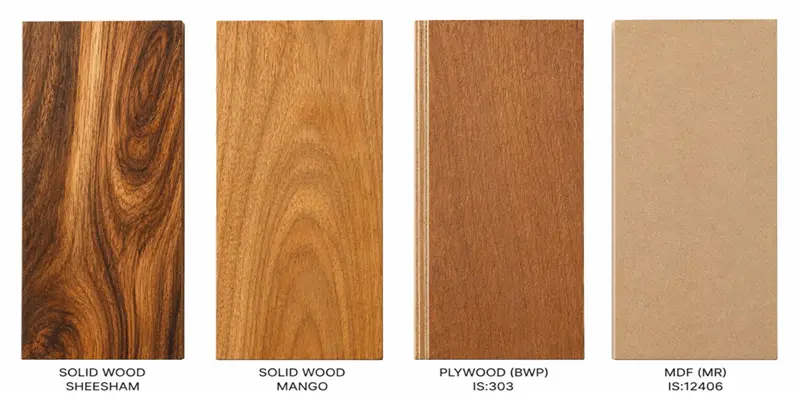
Sheesham or Indian Rosewood is a hardwood that is native to the Indian sub-continent. Sheesham wood is amongst the most widely used wood species when it comes to making furniture in India. Sheesham is dense and is known for its grains that have colors ranging from golden to dark brown. Sheesham wood is suited for beds, dining tables, chairs, and sofas. It is receptive to stains and polish. Density is measured in terms of weight, and the denser wood gives more sturdiness.
Teak: Naturally Resistant and Premium Priced
The timber is highly appreciated because it has the characteristics of stability and strength since it does not get attacked by insects and decays naturally. The timber has properties that ensure protection against termites and fungus, which is the reason why the timber is often used outdoors. The teak timber has the quality of dimensional stability, whereby it does not change with changes in moisture content, unlike other types of timber. The timber is very expensive. At present, the majority of the teak timber available in the market is plantation timber; thus, it is important to find out where the timber is sourced from.
Mango Wood: Affordable and Increasingly Popular
Mango wood has become very popular in the manufacture of furniture, particularly dining table sets. The mango wood is taken from the mature mango tree, which does not bear any fruit; hence, the wood is taken from the part of the tree which would otherwise have gone to waste. This wood has an attractive grain, and it is of brownish color, which can vary from light brown to dark brown. This wood is of moderate hardness but slightly less hard as compared to sheesham and teak woods.
Plywood, MDF and Particle Board
The advantages of the boards include low price, straight edges, and a smooth surface, which make them suitable for carcasses, drawers, and backs. The plywood comprises layers of thin veneers which are put together using an adhesive. The layers used in the production of the plywood have varied grain patterns. The plywood has good stability and strength-to-weight ratio because of the cross-lamination of the thin veneers. Water resistance depends on the quality of the plywood, and boiling water-proof plywood is meant for use in difficult conditions. The boiling water proof plywood is usually called BWP. The medium density fibreboard, which is known as MDF, consists of wood fibres joined together using resins. The surface of MDF is flat, and it is easy to paint and laminate.
Veneers and Laminates
Veneer consists of wood layers applied on a base material like plywood and MDF. This makes it possible for furniture made of veneers to look like expensive wood while using a small amount of wood. Laminate is the name used to describe artificial decor added to a substrate that usually mimics wooden or stony looks. Such materials will look great and perform well in ordinary conditions. Take care of possible damage around the edges of such items, as problems arise from there.
Termites, Humidity and Long-Term Stability
Termites pose a serious threat in most houses in India, and their susceptibility differs with species and type of the material. Teak and sheesham wood are resistant to termites, while particle boards and softwoods that are not treated are prone to them. Engineered boards cannot escape the wrath of termites. Particle boards can be affected when they contain organic materials. Wooden materials must be treated and inspected periodically. Humidity can affect any wood material. Place your furniture away from walls and air conditioners.
Choosing Materials by Room and Use
Use the appropriate material for its use. Furniture for the dining table and beds bears much stress and should, therefore, use hardwoods such as sheesham and teak. For furniture that includes bookshelves and wardrobes, plywood will do fine due to its strength and stability. It is not costly, too. For decorative articles which will be placed in a room where there is not much traffic, you may use mango wood and veneer panels.
Reading Product Descriptions Carefully
The product descriptions would also include language which may appear to be the same but which is talking about entirely different types of construction. "Wood finish" and "wood look" are words that are used when a laminate or veneer has been applied to a non-wood substrate. The product description of solid wood would include the name of the wood, while the description of an engineered board would include details of the core of the board. The product description that does not include any of this information must be questioned.
Conclusion: Read the Label With Confidence
By having an idea of the different kinds of woods and boards, one will be able to determine the quality of the furniture from the material used rather than looks. Hardwood is strong and can be repaired; plywood is made and thus stable, whereas MDF and particle board suit better where economy and aesthetics come into play. It would be better to inquire with the sellers about the wood used.
